Search isn't ten blue links anymore. Is your brand in the answer?
Generative Engine Optimization (GEO) is the practice of structuring a brand's content and data so AI answer engines — ChatGPT, Perplexity, Google AI Overviews — can find it, trust it, and cite it correctly.
A growing share of searches now end inside an AI-generated answer, not a list of links. If an AI engine can't parse who you are, what you offer, and why you're credible, it skips you — even if you'd rank well in classic search. GEO closes that gap before it costs you visibility.
AI engines rely on Schema.org markup and consistent facts to understand who a business is — not just what its homepage copy says. We implement Organization, Service, and FAQPage structured data, and make sure your name, address, and offerings are stated the same way everywhere they appear.
AI models extract answers more reliably from clear definitions, direct Q&A, and specific claims than from marketing prose. We restructure key pages — like this one — into a format a language model can quote accurately, not paraphrase incorrectly.
AI engines weigh trust signals — reviews, consistent citations, backlinks from credible sources — heavily when deciding what to surface. We build the proof points (case studies, testimonials, third-party mentions) that give an AI model a reason to recommend you.
We track how ChatGPT, Perplexity, and Google AI Overviews describe your brand over time, catch inaccuracies early, and adjust the underlying content and data before a wrong description spreads across more answers.
Proof, not promises
Related work.
-
Takımsan
Website and search optimization for an industrial extruder manufacturer. Organic traffic and inbound leads rose sharply after launch.
-
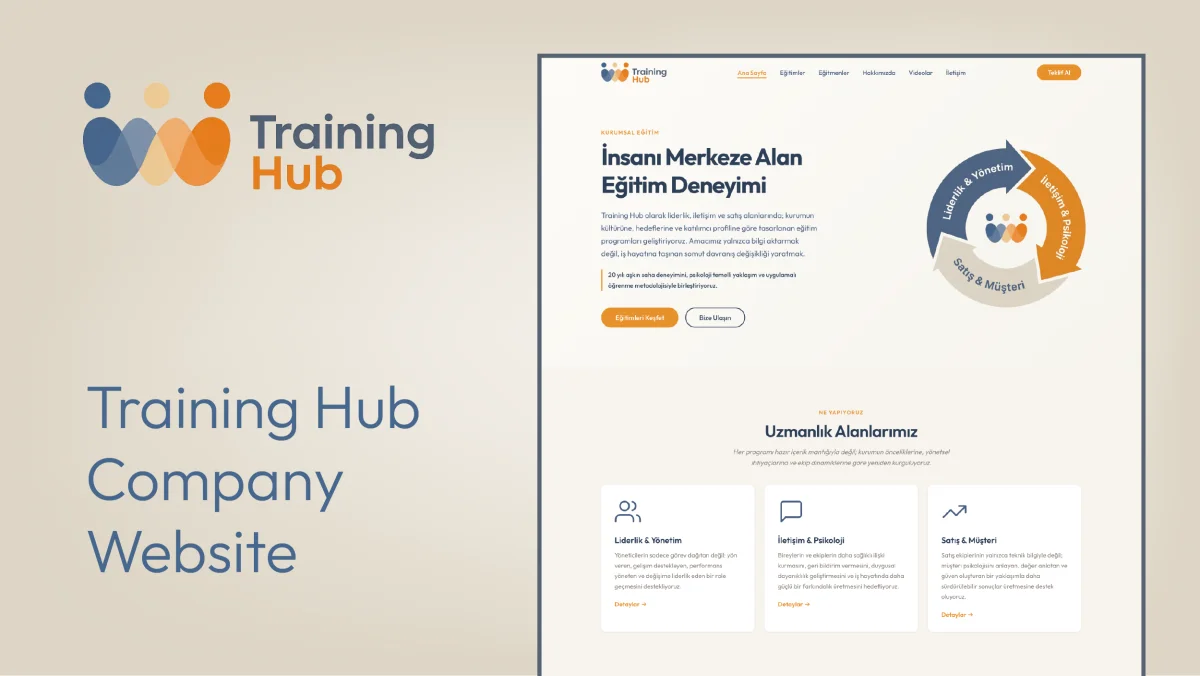
Training Hub
Website and search optimization for a corporate training provider. Site visits and lead generation increased significantly post-launch.
-
Bunudene
Brand and web presence for a UX and LxD testing platform, optimized for classic search and AI answer engines.

Common questions
GEO, answered.
What is GEO (Generative Engine Optimization)?
GEO is the practice of structuring a brand's website, content, and data so that AI answer engines — ChatGPT, Perplexity, Google AI Overviews, and similar tools — can accurately find, understand, and cite that brand when answering a user's question.
How is GEO different from SEO?
SEO optimizes for ranking in a list of links a person clicks through. GEO optimizes for being the source an AI model cites, quotes, or recommends inside a generated answer, where the user may never visit the site directly. GEO relies on clear entity definitions, structured data, and extractable content rather than keyword ranking alone.
Can you guarantee my brand will be mentioned by ChatGPT?
No one can guarantee inclusion in a specific AI-generated answer, since these models don't expose ranking factors the way search engines do. What Custeo does is remove the reasons an AI engine would skip or misrepresent a brand: missing structured data, vague entity information, no citable proof points, and inconsistent facts across the web.
What does a GEO engagement with Custeo include?
An entity and content audit, Schema.org structured data implementation (Organization, Service, FAQPage, and related types), content restructured into clearly extractable definitions and Q&A, consistency checks across the web (name, address, phone, LinkedIn, directories), and ongoing monitoring of how AI engines describe the brand.
Do I need SEO and GEO, or just one?
Most brands need both. GEO builds on the same technical foundation as SEO — a crawlable, fast, well-structured site — and adds the entity clarity and structured data that AI engines specifically require. See our SEO page for the foundational work.
Ask ChatGPT about your industry. See who comes up.
If it's not you, let's fix why.
Start a GEO Audit